Almaty’s Iconic Duo and Their Intertwined Legacy
In the heart of Almaty, Kazakhstan’s vibrant cultural capital, lie two landmarks that are more than mere points on a map. They are the twin souls of the city: a Russian Orthodox cathedral of otherworldly beauty and a park steeped in solemn remembrance. The Ascension Cathedral (better known as Zenkov Cathedral) and the Park of 28 Panfilov Guardsmen (Panfilov Park) are not just neighbors; they are partners in a shared history, their legacies intertwined through a century of imperial ambition, seismic upheaval, Soviet transformation, and national rebirth.
To understand one is to appreciate the other, for their stories are woven from the same historical thread of Russian Orthodox Church expansion, Soviet Kazakhstan nation‑building, and modern Kazakh identity.
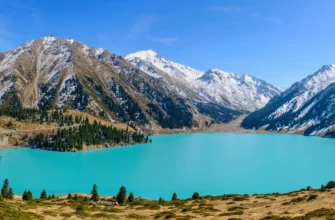
This destination has become a cornerstone of the visitor experience in a city that is rapidly gaining international acclaim as a tourism hub. By mid‑2024, around 1.1 million visitors had stayed in Almaty’s hotels, with international travelers making up over a quarter of all guests, drawn by both its urban culture and nearby natural wonders such as Ile‑Alatau National Park. The cathedral and park stand as a testament to the enduring character that makes this city so compelling. Any serious Ascension Cathedral travel guide or Almaty tour package will place this ensemble at the very heart of an itinerary.
Unveiling Ascension (Zenkov) Cathedral and Panfilov Park
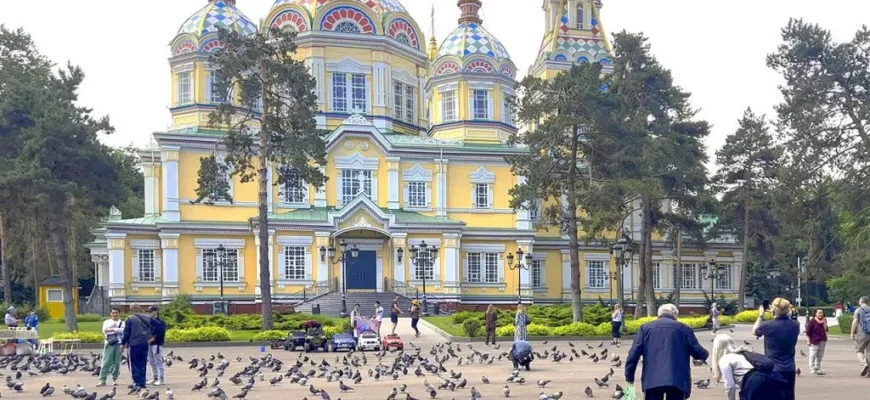
Ascension Cathedral, officially dedicated to the Feast of the Ascension, is a riot of color against the Almaty sky – a fairytale structure of candy‑colored domes and intricate woodwork that seems almost unreal. Often likened by visitors to a Central Asian cousin of St Basil’s Cathedral in Moscow, it combines traditional Russian “tent and onion‑dome” forms with audacious engineering. One of the tallest wooden churches in the world, it rises about 54–56 meters and serves as a major spiritual center of the Orthodox Russian Church in Central Asia.
The cathedral stands within the leafy embrace of Panfilov Park, officially the Park of 28 Panfilov Guardsmen. This is Almaty’s “green lung” in the old city: an 18‑hectare oasis of deciduous trees, smooth alleys, and shaded benches, interwoven with powerful war memorials and cultural institutions. It is both the cathedral’s tranquil setting and a destination in its own right, known for the Memorial of Glory (often called the Glory Memorial) and its eternal flame in honor of World War II soldiers.
Together, Ascension Cathedral and Panfilov Park form a compact historic quarter that blends cultural heritage, living faith, and public memory.
A Narrative of Shared History and Enduring Resilience
The connection between these two sites runs deeper than proximity. They emerged in the same era, were shaped by the same geopolitical forces, and have endured the same seismic threats. From devastating earthquakes to ideological campaigns of the Soviet times, their parallel journeys mirror Almaty’s own story of resilience.
Both the cathedral and the park have shifted meanings over time – from imperial showpieces to Soviet civic institutions, then back to spiritual and memorial spaces after independence. Together, they offer a narrative of faith, sacrifice, and adaptation in a city that continuously reinvents itself while retaining its profound history.
The Genesis of Grandeur: Envisioning Verny’s Early Heart
In the late 19th and early 20th centuries, the city now known as Almaty was called Verny, a growing outpost of the Russian Empire at the foot of the Tian Shan mountains. It was strategically important and increasingly prosperous, and its planners wanted monuments that would signal both imperial presence and urban ambition.
This vision produced two linked projects: a grand Orthodox cathedral for the expanding Russian community and a formal city garden that would become the city’s main public space. The result is the ensemble now known as Ascension Cathedral in the Park of 28 Panfilov Guardsmen.
A Cathedral for a Flourishing City: Between Earthquakes and Empire
The idea of building a major Russian Orthodox Church in Verny was discussed by the first bishops of the Turkestan eparchy in the late 19th century. But it was the 1887 earthquake – long before the cathedral was built – that decisively shaped its future form. Stone buildings across the city collapsed, while wooden structures largely survived, convincing planners that any future cathedral had to be constructed in timber.
The project also aligned with the late‑imperial mindset leading up to the Romanov Tercentenary of 1913: monumental churches across the empire were used to signal loyalty to the dynasty and the Orthodox faith. In Verny, a major Orthodox cathedral at the empire’s southeastern frontier served both spiritual and political goals – anchoring Russian settlers and visually asserting imperial authority.
Formal construction began after Bishop Paisii of Turkestan and Tashkent consecrated the foundation on 26 September 1903; work proceeded between 1904 and 1907.
Architectural Ingenuity: Borisoglebsky and Zenkov’s Wooden Marvel
The original project was authored by architect K. A. Borisoglebsky (Konstantin Arkadyevich Borisoglebsky), who incorporated an innovative structural idea he termed a “seismic basket” to protect the building against future earthquakes. However, Borisoglebsky left Verny in 1902. It was engineer A. P. Zenkov (Andrei Pavlovich Zenkov), the regional engineer, who revised the plans, adapted them to local conditions, and oversaw the construction; hence the cathedral is widely known as Zenkov Cathedral.
The building is constructed primarily from Tian Shan spruce (often called Schrenk’s spruce), an exceptionally strong local timber. The sections are connected by metal bolts and braces, not literally without metal as popular legend claims. The oft‑repeated notion that the cathedral was built “without a single nail” is a romantic simplification; in fact, the structure uses a sophisticated system of wooden joinery combined with metal fasteners to allow controlled flexibility under seismic load.
In effect, the cathedral is an earthquake‑resistant monument: the “seismic basket” system allowed it to sway rather than crack, an early example of applied architectural ingenuity in a highly seismic activity zone.
From the outside, the cathedral’s vibrant architecture – multi‑colored façades, tiered domes, and elaborate carpentry – invites comparison to Russian fairy‑tale churches and iconic models like St Basil’s Cathedral, but executed entirely in wood. Inside, its spacious halls, chandeliers, intricate wall paintings, and the remarkable iconostasis by artist N. Khludov create an atmosphere of spiritual solace and visual richness.
Panfilov Park’s Early Origins: From Cemetery to City Garden
The surrounding park has its own layered story. Established in the 1870s on the site of a Cossack cemetery, it was first known as Starokladbischensky Park (“Old Cemetery Park”). Over time it absorbed adjoining green spaces such as a Catholic Garden and was renamed Urban Garden.
In 1899, in honor of the centenary of the poet Alexander Pushkin, it was renamed Pushkin Garden. By the early 20th century it was already a principal recreational area of Verny, laid out with alleys and tree plantings that would later frame the new cathedral.
From the beginning, there was an intentional symbiosis: a formal garden for promenades and a monumental Orthodox church as its focal point. This ensemble anticipated what Panfilov Park would become – a space where civic life, leisure, and spirituality intersect.
Just west of the park, Arasan Baths, a grand Soviet public bathhouse complex completed in 1982 on the orders of First Secretary Dinmukhamed Kunayev, added another layer to the area’s urban life. This modernist spa, with its domes, marble interiors, and social atmosphere, turned the wider neighborhood into a zone of relaxation and everyday rituals, complementing the more solemn atmosphere inside the park itself.
Surviving the Earthquake: A Testament to Vision
The ultimate test of the cathedral’s design and the city’s resilience came with the 1911 Kemin earthquake (also called the Chon‑Kemin earthquake), one of the most powerful in the region’s recorded history, with a magnitude estimated around 7.7.
The Cathedral’s Stand Against Nature
The quake devastated Verny, destroying or severely damaging many brick and stone buildings. Yet the wooden Ascension Cathedral remained structurally intact, suffering only minor damage such as cracked windows and a slightly shifted bell tower.
Contemporaries interpreted this survival in two ways: for the faithful, it was a miracle and a sign of divine protection; for engineers, it was a spectacular confirmation of the “seismic basket” concept and the wisdom of choosing wood over masonry in a seismic zone.
Later accounts recall that the bell tower swayed “like the top of a tall tree in a strong wind” – bent but unbroken – a vivid demonstration of flexible design at work.
The Park as Refuge
In the immediate aftermath, the open spaces of what would become Panfilov Park served as an improvised refuge for residents afraid to remain in enclosed buildings. While detailed descriptions of the park’s role during the earthquake are sparse, the logic of seismic safety made large gardens and squares the safest gathering places, and later memory associated Panfilov’s leafy avenues with collective resilience.
Over time, the park and cathedral together came to symbolize the city’s ability to withstand natural disasters and remain in pristine condition relative to the destruction surrounding them.
Through the Tides of History: Transformation and Remembrance
The 20th century brought revolutions, wars, and ideological campaigns that altered the function and meaning of both cathedral and park. Their sacred and civic roles were repeatedly rewritten under Soviet Kazakhstan.
Zenkov Cathedral in Soviet Times: Museum, Radio Tower, and Revival
After the Bolshevik Revolution, anti‑religious policy led to the closure of many churches. The Ascension Cathedral was eventually shut for worship and, by the 1930s, repurposed to house the Central State Museum of the Kazakh Soviet Socialist Republic (Kazakh ASSR). Its religious icons and furnishings were partially removed or concealed, and the building was treated primarily as a historic monument and exhibition space with extensive exhibits on archaeology, ethnography, and Soviet development.
The bell tower took on a new, symbolic function: it hosted Almaty’s first radio transmitters, making the former belfry a literal broadcasting tower for Soviet modernity.
Between 1930 and 1940, the cathedral building also accommodated various public organizations, emphasizing its secularized role.
In the 1970s, Soviet authorities recognized the importance of the structure as an architectural landmark; a major restoration campaign was carried out from 1973 to 1976, focusing on retaining its wooden fabric and ornamental details.
After independence, the tide turned again. In May 1995, the cathedral was formally returned to the Russian Orthodox Church, and in 1997 it reopened for religious services after additional restoration. From 2017 to 2020, a new phase of large‑scale reconstruction addressed both structural and decorative elements, ensuring that the cathedral could continue functioning as an active church and as one of the city’s most important cultural heritage sites.
Panfilov Park’s Soviet Recasting: From City Garden to War Memorial
The park’s identity changed decisively during and after World War II. In 1942, it was renamed the Park of 28 Panfilov Guardsmen in honor of a group of Red Army soldiers from the 316th Rifle Division, commanded by General Ivan Panfilov, who allegedly died in heroic combat near Moscow in 1941, stopping German tanks during Operation Barbarossa.
The story of the Soviet troops known as “Panfilov’s Twenty‑Eight” became one of the most famous wartime legends in Soviet memory culture, regardless of later historical debates about its exact factual basis. The renaming endowed the park with a powerful memorial function, turning everyday strolls into encounters with national mythology.
At the heart of this new identity is the Memorial of Glory, a monumental sculptural composition representing soldiers from the 15 Soviet republics, charging forward in eternal defense of their motherland. In front of it burns an eternal flame, commemorating those who died in the war. This ensemble, sometimes simply called the Glory Memorial, remains one of the most emotionally charged sites in Almaty.
Under Soviet rule, Panfilov Park hosted official cultural festivals, military parades, and commemorative ceremonies, embedding the memory of the Great Patriotic War into everyday urban life.
A Sanctuary of Peace, Reflection, and Cultural Heritage Today
In independent Kazakhstan, Zenkov Cathedral and Panfilov Park have woven their complex histories into a harmonious whole. They now function as a unified destination that offers spiritual solace, historical reflection, and calm green space in the midst of a fast‑growing metropolis.
Inside the Cathedral: Living Faith and Artistic Splendor
Stepping into the restored Ascension Cathedral reveals a rich interior: large open spaces, gilded chandeliers, vivid frescoes, and the multi‑tiered iconostasis by N. Khludov, many elements dating back to the early 20th century. Light filters through high windows, illuminating icons and wall paintings in traditional Russian style.
As an active Orthodox Russian church, the cathedral holds regular services and prayer times, with special liturgies on religious holidays such as Easter and the Ascension. Visitors can experience the atmosphere of sung liturgy, incense, and quiet personal devotion.
For a history enthusiast, the building is also a living museum of pre‑revolutionary craftsmanship and early seismic engineering, still standing in remarkably pristine condition after more than a century of earthquakes, political change, and restoration.
There is no fixed entrance fee for casual visitors who respectfully enter outside of services; donations are welcomed to support ongoing maintenance. Modest dress and discreet behavior are expected, especially during liturgy.
The Reflective Green Space of the Park
Panfilov Park complements the intensity of the cathedral’s interior with open air and greenery. Its smooth paths and alleys lead through a mixed grove of oaks, elms, aspens, maples, poplars, pines, and firs, offering shade and coolness in summer. Benches encourage lingering, while families, couples, and tourists share the space.
Approaching the Memorial of Glory, the atmosphere changes. The massive sculptural relief, with figures representing all 15 Soviet republics, and the eternal flame in front of it, invites silence and reflection on wartime sacrifice. On significant dates such as Victory Day, veterans, officials, and citizens lay flowers here, maintaining a strong connection to the memory of World War II and the role played by Kazakh soldiers and other Soviet troops.
On the park’s edge stands the Kazakh Museum of Folk Musical Instruments, housed in a charming wooden building. Its extensive exhibits of dombras, kobyz, and many other instruments provide a deeper dive into Kazakh and Central Asian musical traditions, expanding the park’s role from memorial space to cultural festivals and educational programs. For the history enthusiast, this combination of sacral architecture, war memorials, and vernacular culture makes the park one of the most layered places in the city.
Beyond the park itself, Almaty’s appeal as a destination rests on its mix of urban culture and easy access to natural wonders. The nearby Ile‑Alatau National Park and other mountain areas offer hiking, skiing, and adventure activity options, completing the contrast between city heritage and outdoor escape.
Almaty’s Shared Cultural Tapestry
Together, Ascension (Zenkov) Cathedral and the Park of 28 Panfilov Guardsmen embody the multiple layers of Almaty’s identity:
- The Russian imperial layer, visible in the cathedral’s architecture and the original Pushkin‑era garden.
- The Soviet layer, expressed in the war memorials, the cathedral’s re‑use as a museum and radio tower, and the heroic narrative of the Panfilov Guardsmen.
- The spiritual layer, revived after independence with the return of the cathedral to the Russian Orthodox Church.
- The Kazakh national layer, in which these sites now function as central elements of the city’s cultural heritage and international image.
For visitors, the ensemble offers a rare chance to experience these overlapping narratives in a single walk: from the Orthodox church with its icons and chants, across the lawns and trees of the park, to the Glory Memorial and the Kazakh Museum of Folk Musical Instruments. It is a compact introduction to the broader cultural fabric of Kazakhstan.
Experiencing Almaty’s Enduring Landmarks Today
A Unified Visitor Experience: History, Spirituality, and Nature
The experience typically begins at one of the main park entrances. Tree‑lined avenues naturally lead toward the cathedral, whose colorful domes appear gradually through the foliage. This approach allows for a sense of discovery rather than an abrupt reveal.
Many visitors choose to walk first toward the Memorial of Glory and eternal flame, paying respects to the fallen of World War II, then circle back through the alleys to the cathedral. The contrast between the park’s open, civic nature and the cathedral’s focused, sacred interior is one of the strengths of this ensemble. It feels less like ticking off two separate sights and more like moving through chapters of a single story.
Given the park’s central location, it is easy to combine a visit here with nearby experiences – a stop at the public bathhouse Arasan for a traditional steam, or a foray into Almaty’s bustling markets and cafés just a short walk away. Many organized Almaty tour packages use this area as a hub, linking spiritual, historical, and everyday urban life.
Practicalities for an Enriching Visit
- Access and cost: Both Panfilov Park and the Ascension Cathedral can be entered free of charge. Donations at the cathedral are welcomed.
- Etiquette: As an active church, the cathedral requires modest clothing and quiet behavior. During services, photography may be restricted; it is best to observe respectfully if you enter at such times.
- Timing: Mornings and late afternoons are particularly atmospheric, with softer light on the domes and cooler temperatures in summer. Visiting on major religious holidays offers a powerful experience, but expect more crowds.
- Guidance: Informal, self‑guided exploration works well, but hiring a local guide or using a detailed Ascension Cathedral travel guide can deepen understanding of the building’s engineering, iconography, and history.
- Staying informed: Opening hours, service schedules, and restoration works may change. It is advisable to stay up to date via current local information before planning your visit.
Conclusion: The Unbreakable Bond at Almaty’s Heart
A Testament to Shared Resilience and Identity
The story of Zenkov Cathedral and Panfilov Park is inseparable from the story of Almaty itself. From withstanding one of Central Asia’s most powerful earthquakes to surviving the ideological currents of the 20th century, they stand as twin monuments to resilience.
One represents spiritual endurance – a church that persisted through closure, secularization, and restoration to return as a living center of worship. The other embodies collective memory – a park that evolved from cemetery to city garden to a principal memorial to World War II sacrifice. Together, they form a coherent portrait of a city that honors both faith and heroism while embracing its role as a modern, open, and culturally rich metropolis.
A Call to Experience a Living Legacy
For any visitor to Almaty, this shared space is essential. It offers the chance to
- walk through more than a century of history,
- witness extraordinary architectural ingenuity in an earthquake‑prone region,
- reflect at a powerful war memorial, and
- find a moment of calm under the trees or within the candle‑lit nave of a wooden cathedral.
These are not static relics. They remain active components of city life – hosting worship, remembrance ceremonies, casual strolls, and cultural events. To experience Ascension Cathedral and Panfilov Park is to engage directly with the living core of Almaty and to understand why this compact ensemble continues to captivate visitors from around the world.
For many journeys through Kazakhstan, the story truly does begin here.